How to sell on Instagram in Nigeria (2026): from post to paid, without losing a DM
Nigerians buy in the DMs. Here is how to sell there: post what sells, reply fast, earn trust, take payment in the chat, record every sale and follow up.
 Bizthom Team
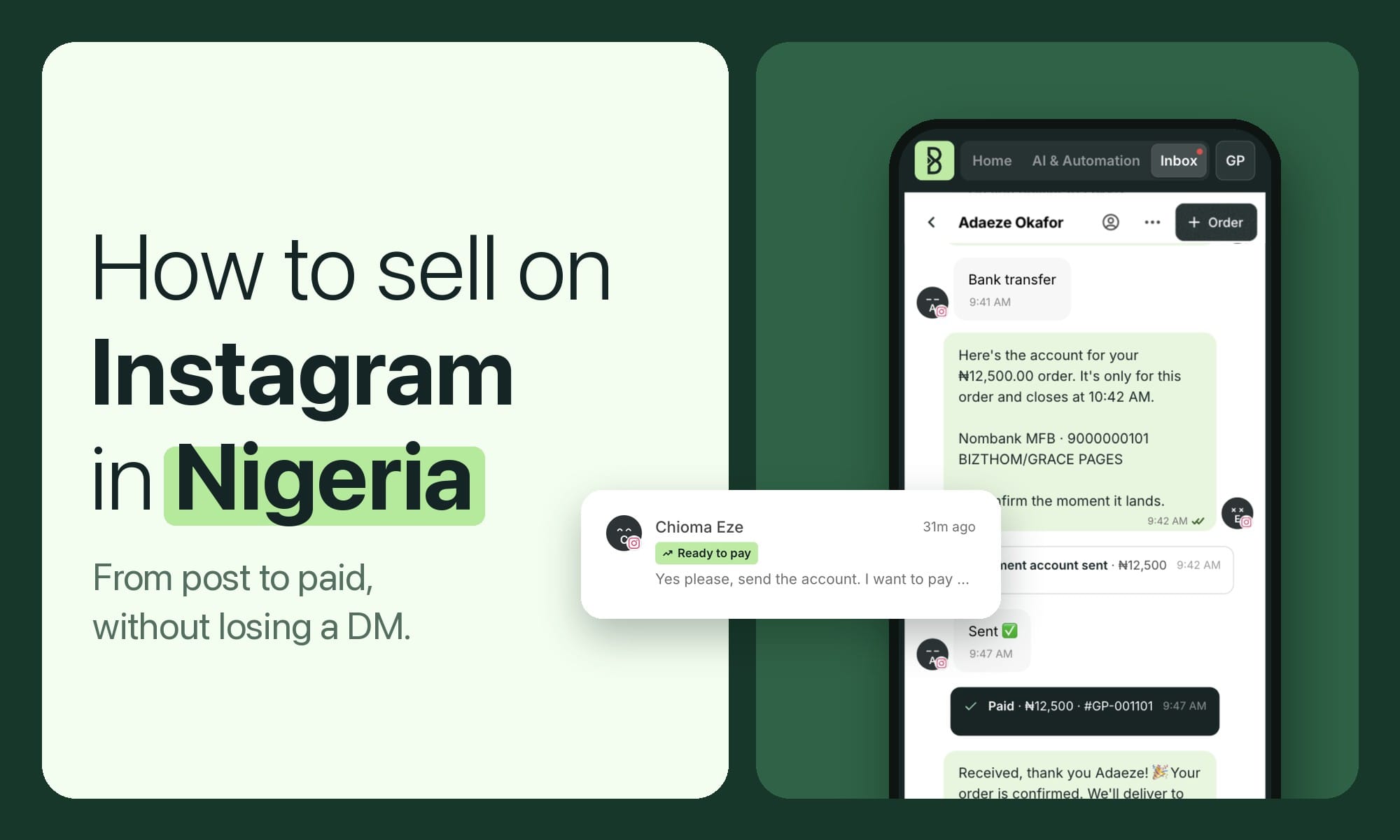
Most Nigerian businesses don't sell on Instagram. They sell in it. Someone sees a reel, comments "price?", slides into your DMs, asks for another colour, asks about delivery to Ikorodu, says "let me get back to you", and maybe sends a transfer two days later. The post gets their attention. The DM is where the money is made or lost.
So this guide spends a little time on posting and a lot of time on what happens after someone messages you, because that's where most sellers lose sales.
We make Bizthom, a platform for selling in DMs, online and in person, so read the parts about our product with that in mind. Every step works without it. Where Bizthom helps, we say how, at the end of the step.
Why Nigerians buy in the DMs, and why it isn't going away
Commerce in Africa is first a conversation. The West had shopping malls from way back: walk in, pick it off the shelf, pay the price on the tag. We had open markets. You greet the trader, you gist, you ask "how much last?", you price it down, you leave and come back. Buying was never just a transaction. It was a conversation, and the conversation is part of how you decide.
Trust is the currency here. Even today, in a local market in Aba, the Igbo trader still has to bend the leather belt in front of the buyer, just to prove it's leather. Nobody takes the seller's word for it.
Now take that buyer online. For many Nigerians, the first experience of shopping online was mixed at best. What arrived was different from what they ordered, or they were scammed altogether. If it didn't happen to them, they know someone who knows someone it happened to.
Put those together and the DM makes sense. It's the one place online where a customer can talk to a real person, ask questions, ask for a video, negotiate, and decide if this seller can be trusted before any money moves. That's not a habit people will grow out of. It's how buying works here.
The numbers say the same:
- 69% of Nigerian social media users have bought or sold through social media, the highest in Africa (Sagaci Research, a survey of over 16,000 people in 28 countries).
- About 98% of Nigerian internet users are on WhatsApp (GWI data, via Yazi).
- What we see on Bizthom: in 1 in 5 sales chats, the customer wanted proof before buying: more pictures, a video, or answers about quality or how to pay. 1 in 6 asked for a discount or a last price. Over a quarter asked about delivery. And chats where the customer doubted the quality sold 45% of the time, more than twice the average. A doubt is a buyer asking to be convinced.
Step 1: Set up your account to sell
Switch to a professional account. In Settings, choose Account type and tools, then switch to a Business account. You get insights on your posts, a contact button, and access to ads.
Make your bio do the work. In one or two lines, say what you sell, who it's for, where you deliver and how to order. "Ready-to-wear for women. Lagos delivery in 24 hrs, nationwide in 3–5 days. Tap the link to order or send a DM."
Put a store in your link in bio, not just "DM for price". A page with your products and prices answers the first question before it's asked, and a buyer who's ready can pay without waiting for you to wake up. If you don't have a website, a catalogue or checkout link still works; more on that below.
Show prices. "DM for price" feels like it starts conversations, but a lot of people won't ask. They scroll past. A price on the post filters out people who can't afford it and brings in people who can. In a third of sales chats we see, the customer has to ask the price. That's a question your post could have answered.
Pin your three best posts. Your best-seller, your most-asked-about item and a post full of customer reviews. New visitors look at the top row first.
Step 2: Post what makes people message you
You don't need to post every day. You need posts that make the right people reach out.
- Reels that show the product being used. The dress on a body, the perfume on a dresser, the hair after installation. Movement sells better than a flat photo, and it answers "is it real?" before it's asked.
- Price and options on the post. Sizes, colours, price and "comment PRICE or DM to order".
- Proof. Screenshots of happy chats (with permission, and with numbers hidden), unboxing videos and delivery photos.
- Stories for urgency. "Only 4 left in black", "Restock lands Friday", a poll on which colour to bring back.
- Ask for the comment. "Comment SIZE and I'll send you the chart." Comments push the post to more people, and every comment is someone telling you they're interested.
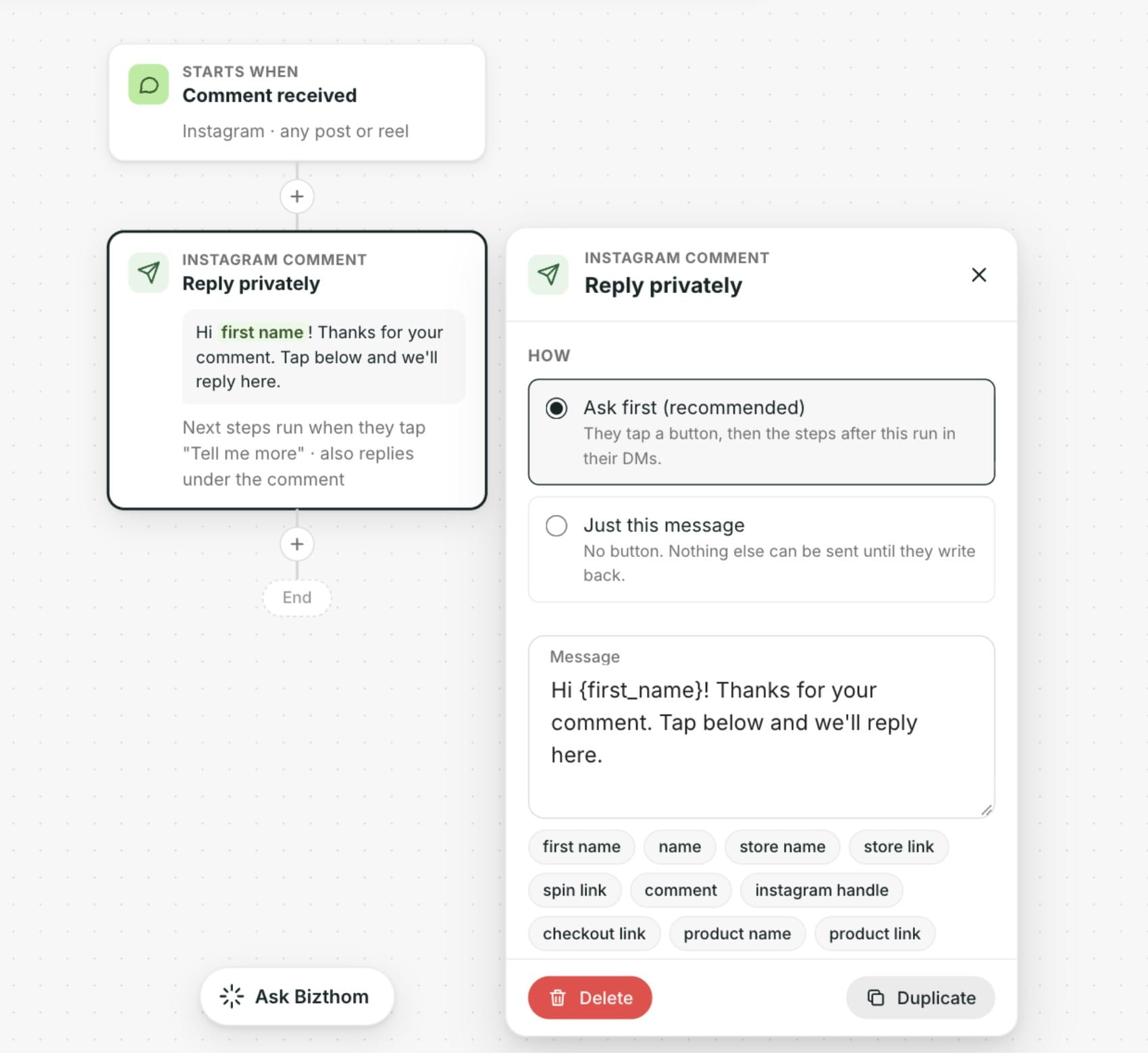
Turn comments into DMs straight away. If 40 people comment "price" and you reply to each one by hand two hours later, half of them have moved on. Reply privately in their DMs as the comments come in, and post a short public reply ("Sent you a DM!") so others see you answer.
On Bizthom: a comment automation does this for you. Pick a post or reel, and when someone comments, they get a private DM with that post's product, and their comment gets a public reply. For giveaways, it can check they follow you before sending the reward.
Step 3: Your DMs need more than an inbox
Most sellers start with free tools. Meta Business Suite puts your Instagram, Facebook and WhatsApp messages in one place and lets you schedule posts. Tools like Buffer schedule your posts across platforms. Meta's new Business Agent can now reply to customers for you, from the catalogue you give it.
They're good at two things: posting, and replying. But replying is only one part of selling in DMs. Here's everything else that happens in a sale, and that you still do by hand:
- Knowing your stock right now. "Is the black one still available in 42?" The answer changes every time you sell one in your shop, on WhatsApp or on your website.
- Getting paid and knowing it landed. Sending an account number, then checking your bank app and matching the transfer to the right customer.
- Recording the sale. Writing it in a notebook or a spreadsheet, so your stock and your records stay right.
- Knowing who's about to buy, and who's just asking. On a busy day, you can't give 80 chats the same attention.
- Knowing who needs a follow-up today. The "let me get back to you" from Monday, the person who got the price and went quiet.
That's where sellers lose money. On Bizthom, more than half of sales chats end with the customer going quiet, and sellers follow up only about 1 in 9 of those. In 3 in 10 chats, at least one customer message goes unanswered, and those chats sell about half as often.
Having every chat in one place is now the easy part. The rest of this guide is about the selling work that happens after a message comes in, and how to do it, with or without software.
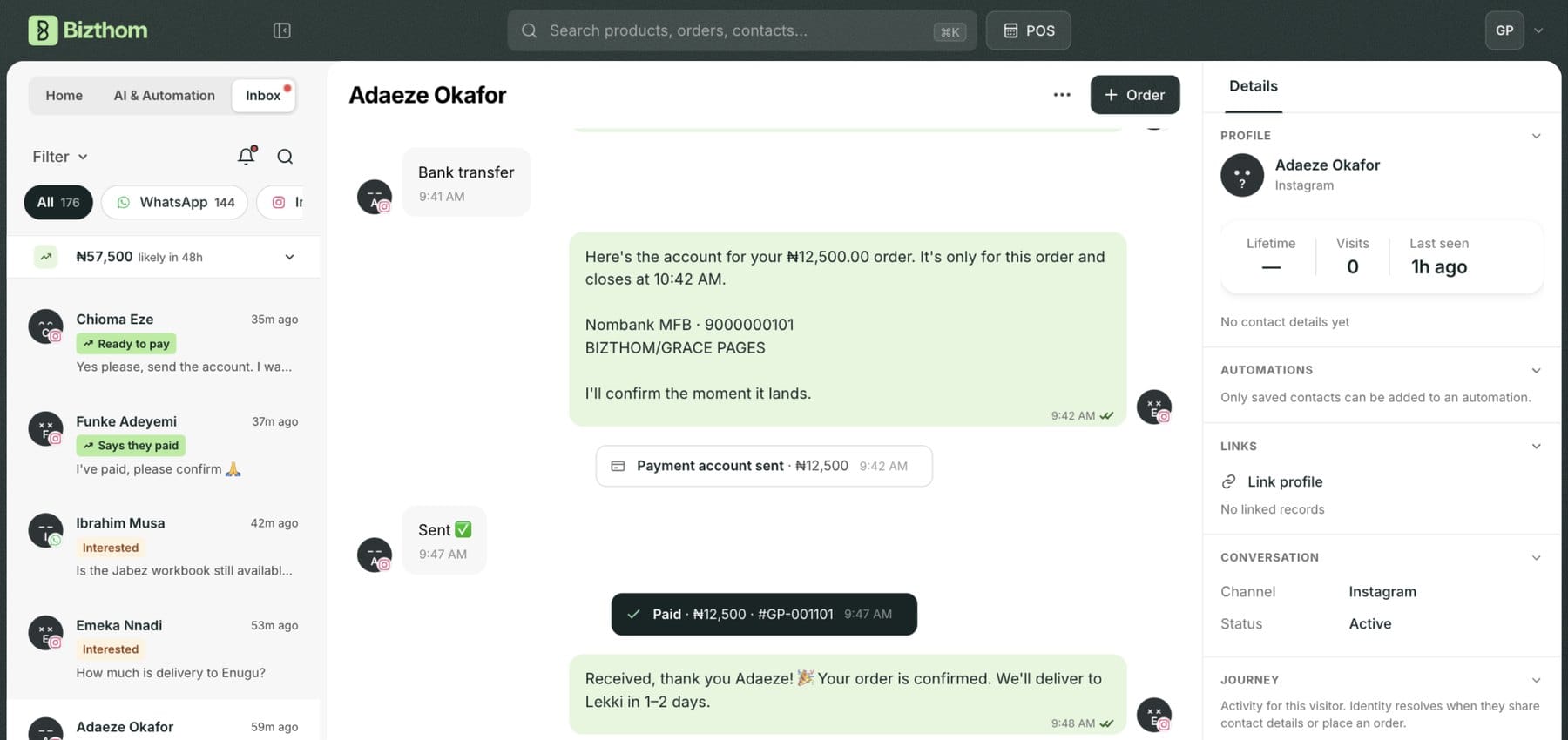
On Bizthom: the Inbox and Ejiro, our AI salesperson, are built for that work. Ejiro replies from your live stock and prices, takes payment in the chat and records the sale. The Inbox shows who's likely to buy, flags who needs a follow-up, and turns a chat into an order in one tap. Each step below shows how.
Step 4: Reply fast, with the real price and stock
Someone asking "how much?" at 11pm is ready now. By 9am they've bought from someone else, or they've cooled off. Chats with an unanswered message sell about half as often, so speed is the cheapest way to sell more.
What a good first reply has: - The price, straight away. Not "Good evening dear, which one?" if you can tell from the post. - Whether it's in stock, in their size or colour. After customers going quiet, "it's not available" is the most common point where we see a sale lost. - A picture or video of the exact item. - The next step. "Which size? I can send it to you today." - Answers to the usual worries before they ask. Delivery time and cost to their area, whether you do pay on delivery, and your return policy.
Save your answers to the five questions you get most (price, delivery, sizes, payment, returns) as saved replies, so whoever is on the phone answers the same way.
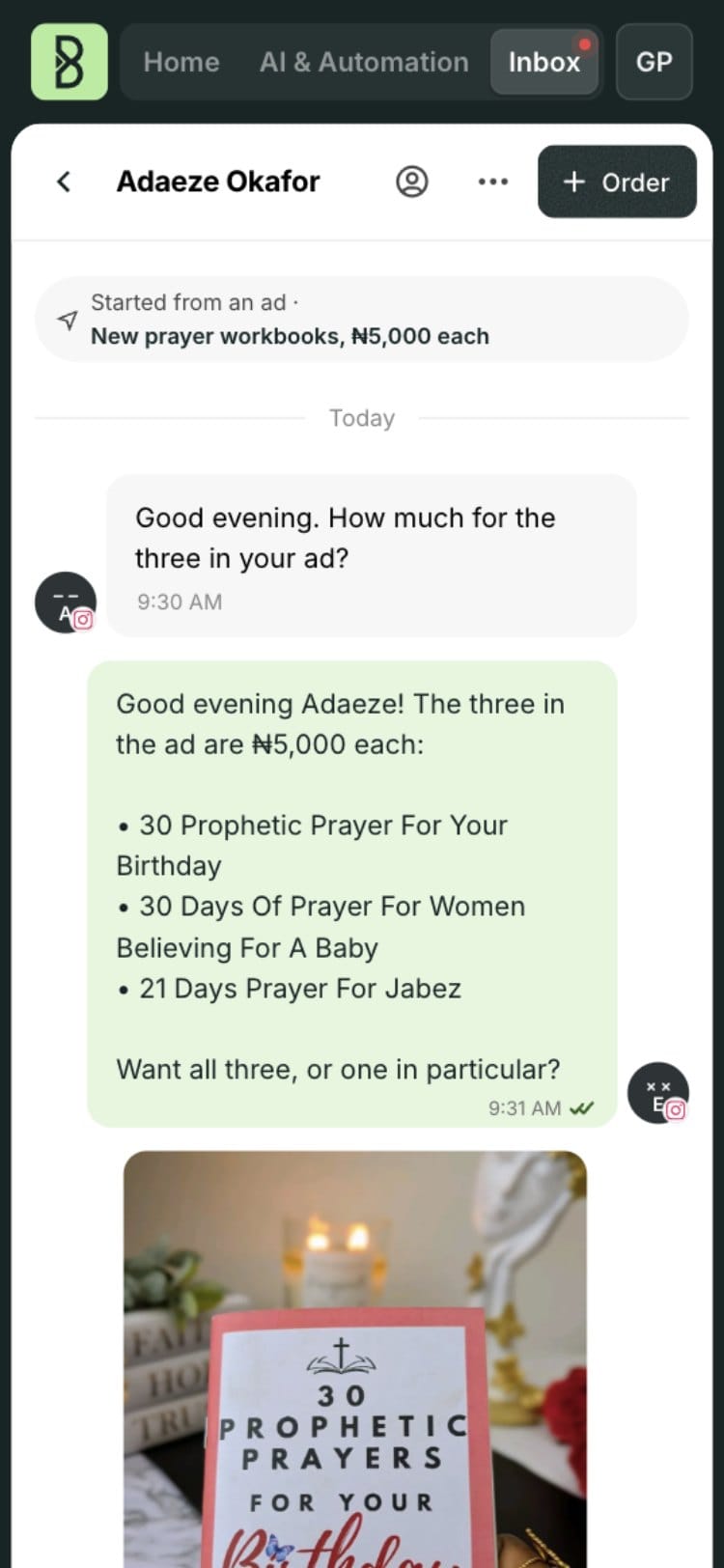
On Bizthom: Ejiro answers your Instagram DMs, Facebook Messenger, WhatsApp and website chat the way your best salesperson would. She checks live stock and prices before she answers, explains your delivery options, sends products as cards with a picture, price and a View product button, and understands voice notes. On WhatsApp, she knows which message a customer is replying to, so "how much is this?" gets the right product. If you reply yourself, she steps back until you hand the chat back.
Step 5: Earn trust, then handle "how much last?"
Online, your customer can't touch the product, so give them the next best thing:
- Send a real video, in your own space, when they ask for proof. Not a stock photo.
- Tell them exactly how delivery works: who delivers, when, and what happens if something's wrong.
- Offer something that lowers the risk if you can: pay on delivery for first-timers in your area, part payment on big orders, or a clear return policy.
When they ask for a discount, don't take it personally. It's how the market works. Decide your lowest price for each product before anyone asks, and stick to it. Instead of cutting the price, try adding something: free delivery, a small extra, or a better price for two. When a seller gives a final price and the customer comes back lower later, hold the final price.
On Bizthom: Ejiro negotiates the way you would, but never below the lowest price you set. A price she offers holds until your hold time runs out, and if the customer offers a price you allow, it goes straight into their bag. When a customer hesitates, she answers the real worry and offers pay on delivery, part payment or your return policy when you've allowed them.
Step 6: Close the sale inside the chat
The moment someone says "I'll take it" is when you're most likely to lose them. You ask for their address, they reply an hour later. You send your account number, they ask "is this your personal account?". They send a transfer, and you have to check your bank app and match it to the right person.
Make paying easy: - Collect everything at once. Name, phone, delivery address, item and size, in one message. - Show the total before asking for money. Item, delivery and any discount, so there are no surprises. - Give a way to pay that doesn't need checking. A payment link, or an account number that's only for that order, so you know who paid without matching screenshots.
In about half of the sales we see, the move that seals it is the seller sending payment details. Nothing else comes close.
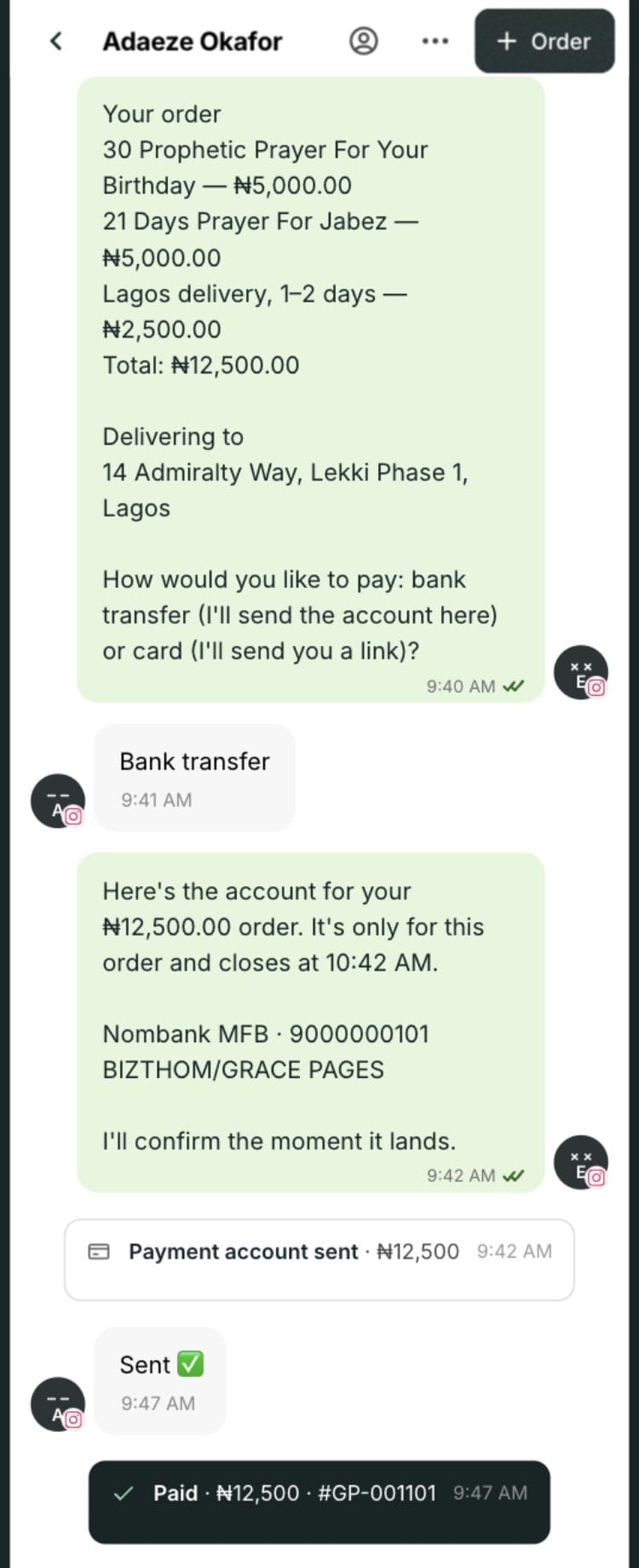
On Bizthom: Ejiro takes a customer from "I want it" to paid without leaving the chat. She collects their details, shows the order and its total, and gives them a one-time account number made for that order, or a checkout that's already filled in. She never sends your personal account. The payment is confirmed the moment it lands, and the sale shows in your inbox. If they don't pay, she reminds them before the account expires.
Step 7: Record every sale, without the notebook
If your sales live in a notebook, your WhatsApp and your head, you don't know what you sold this month, which item is running out, or who your best customers are. And you'll sell something that's already gone.
Record every sale the moment it's agreed: the customer, the items, the price you agreed, the delivery address and whether it's paid. That one habit keeps your stock right across Instagram, your website and your shop.
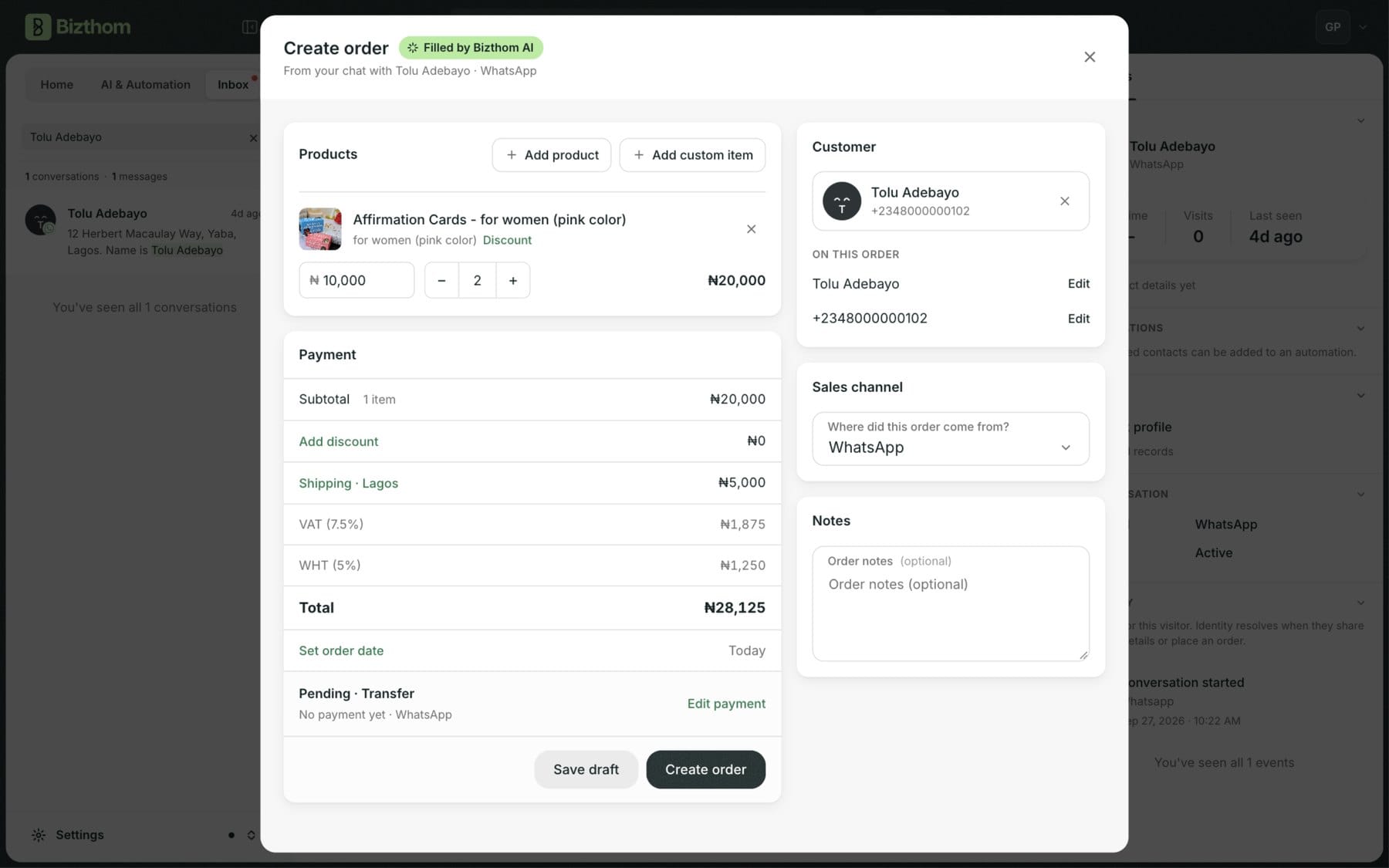
On Bizthom: sales Ejiro closes are recorded for you. When you close one yourself, tap Create order in the chat and Bizthom AI fills it in from the conversation ("send 2 of the red one to Yaba"); you check it and save. Send the receipt or invoice from the chat. Stock updates everywhere at once, so your website, shop and DMs never sell the same last piece twice.
Step 8: Know who's ready to buy, and who's just asking
On a busy day, answer the people closest to paying first. The signs: they send their address, ask for an account number, pick a size, ask "is it still available?", or say they've paid. A customer who came from your ad and asked for the price is warm too.
And learn to spot the ones who aren't buying today, so you're polite but don't spend your evening on them.
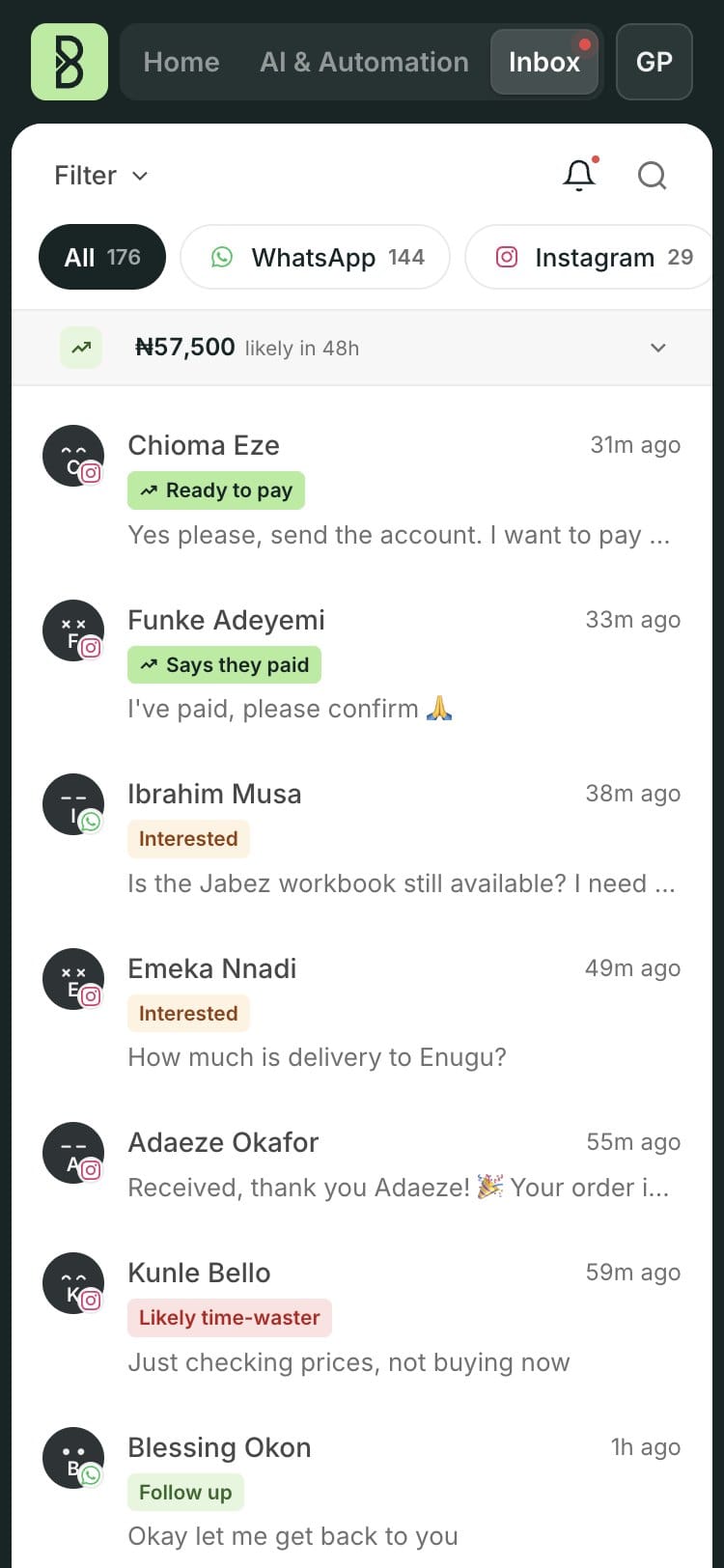
On Bizthom: the Inbox reads each chat and marks it Ready to pay, Interested or Likely time-waster, with the reason (for example "asked for the account" or "came from your ad"). Open a chat and you also see what's holding the buyer back, like stock, delivery or fit. A strip at the top shows what all your likely-to-buy chats are worth, and one tap filters to them.
Step 9: Follow up, because most people don't buy on the first chat
"Let me get back to you" usually means "remind me". Chats where the seller follows up sell 35% of the time, against 16% where they don't. Yet most quiet chats are never followed up.
Who to follow up: - People who got the price and went quiet. - People who asked about availability, delivery or payment and didn't come back. - People who started an order and didn't pay, or left items in their bag on your website. - Past customers, when something they'd like comes in, or on their birthday.
Keep it short and useful: "Hi Tolu, the black one in size 12 is still available. Want me to hold it for you till 6pm?" Don't chase the same person twice in one day, and stop when they say no.
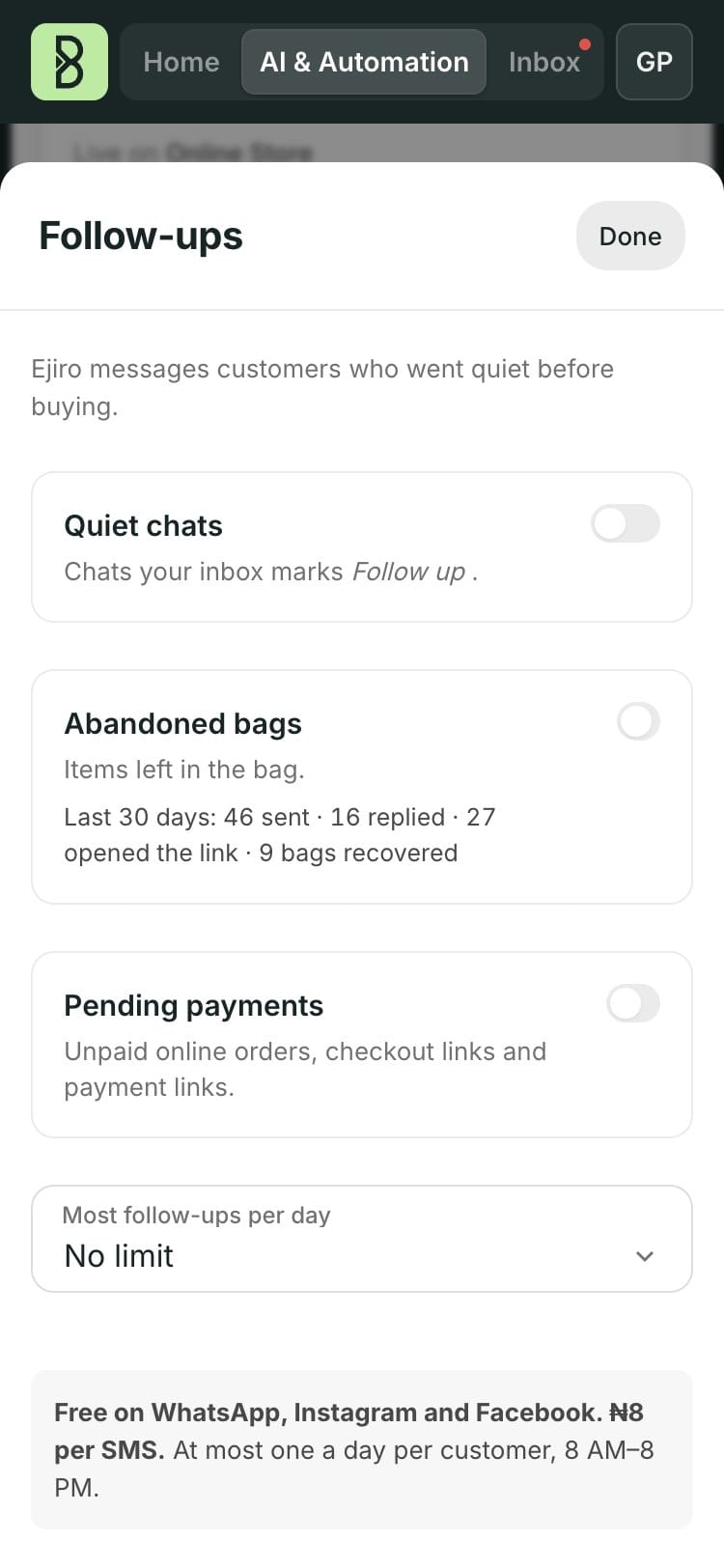
On Bizthom: the Inbox flags every chat that needs a follow-up and why (price quoted, availability asked, payment details pending), with a morning digest of who to chase today. Ejiro can follow them up for you on WhatsApp, Instagram and Facebook. Abandoned bags get two reminders a day apart, only if the customer hasn't replied, ordered or asked to stop. If someone on your team replied last, Ejiro waits a day so the customer isn't chased twice. For each kind of follow-up, you see the last 30 days: how many were sent, how many replied, how many opened the link and how many bags were recovered.
Step 10: Run ads that land in your DMs
Click-to-message ads ("Send message" ads on Instagram or Facebook that open a chat on WhatsApp, Instagram or Messenger) turn ad money straight into conversations. Three tips:
- Name the products in the ad's headline, exactly as you name them in your store.
- Have someone ready to reply while the ad runs. An ad that sends 100 chats to an inbox nobody answers is money burned.
- Track which ad brought which sale, not just which ad got the most clicks.
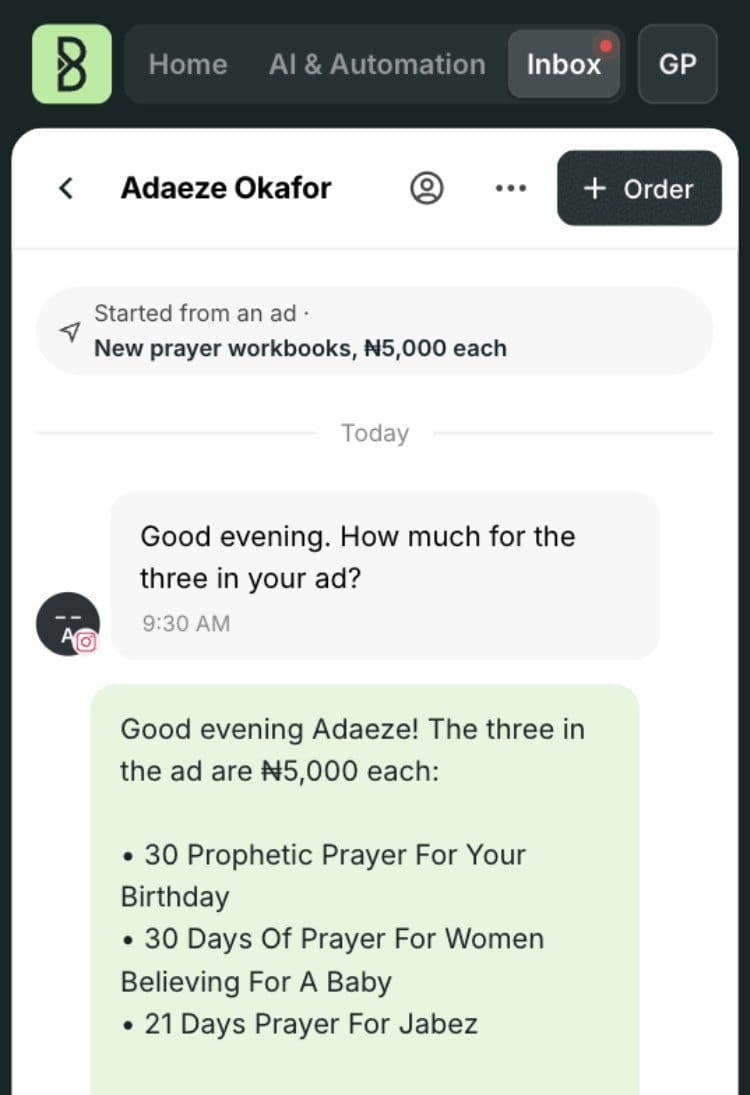
On Bizthom: when someone taps your Instagram ad and lands in your DMs (or on WhatsApp), Ejiro sees which ad they came from and which of your products it names. If they ask "how much for the three?", she answers with the price of each one instead of asking which ones they mean. An automation can also reply to everyone who comes from an ad, with a checkout link made just for them, or hand them to Ejiro or your team.
Step 11: Turn happy chats into reviews
Your DMs are full of "I love it!!!" and "it fits perfectly". That's the proof your next customer is asking for. Ask if you can share it, and post it where new buyers will see it: Stories, a pinned highlight, and your website.
On Bizthom: mark a chat as a review and the praise goes onto your website as a review.
How to sell on Instagram without a website
You can. Plenty of Nigerian businesses do well with an Instagram page and a WhatsApp number. What you need is the jobs a website does, done some other way:
- Somewhere to see your products and prices: a catalogue link, Story highlights per category, or a price list pinned as a post.
- A way to pay that doesn't need checking: a payment link or a one-time account number per order.
- A record of every order: a spreadsheet at minimum, and an order system once you're doing more than a few a day.
Instagram-only selling gets hard when you grow: more chats than you can answer, staff replying from different phones, stock running out because a sale wasn't recorded, and nobody following up. That's usually the point to add a store link and a proper way to run your DMs.
On Bizthom: your store and your DMs work as one system, so your link in bio, your Instagram DMs and your WhatsApp sell from the same stock, prices and customer records. If you're coming from WhatsApp, Bumpa, Shopify or WooCommerce, you can import your products and customers, or we'll move your store for you.
A simple checklist
- Business account, clear bio, store or catalogue link in bio
- Prices on posts; top three posts pinned
- Reels showing the product in use; proof in Stories and highlights
- Comments answered in DMs within minutes
- First reply has the price, the stock, a picture and the next step
- A lowest price for every product, decided before anyone asks
- Payment that doesn't need checking by eye
- Every sale recorded the moment it's agreed
- Ready buyers answered first
- One follow-up for every chat that went quiet
- Ads that name the products, with someone (or something) ready to reply
- Happy chats turned into reviews
Frequently asked questions
Why do Nigerian customers prefer to buy in DMs? Because buying here has always been a conversation, and because trust has to be earned before money moves. In a DM, a customer can ask questions, see a real video, agree delivery and negotiate, the way they would in a market.
Can I use Instagram Shop in Nigeria? Not at the moment. Nigeria isn't on Meta's list of supported countries for Shops, so you can't tag products or check out on Instagram. Selling happens through DMs and a link in your bio.
Isn't Meta Business Suite enough? It's a good free way to reply to Instagram, Facebook and WhatsApp messages in one place and to schedule posts. It isn't built to keep your stock right, confirm a transfer, record the sale, or tell you who's about to buy and who needs a follow-up. Those are the jobs that decide whether a chat becomes a sale.
Can AI really reply to my Instagram DMs? Yes. On Bizthom, Ejiro replies to Instagram DMs, Facebook Messenger and WhatsApp with your live prices and stock, negotiates within your limits, and takes payment in the chat. She hands the chat to you when she should, and steps back whenever you reply yourself.
Do I need a website to sell on Instagram? No, but you need what a website gives you: a place to see products and prices, an easy way to pay, and a record of every order. A store link makes all three easier as you grow.
Ready to sell more in your DMs? See how Bizthom works or see pricing.
Related: Bumpa alternatives in Nigeria, honestly compared · A shoppable blog for your online store
The Bizthom letter
One email a week: what's working for Nigerian merchants selling in DMs, online and at the counter.